
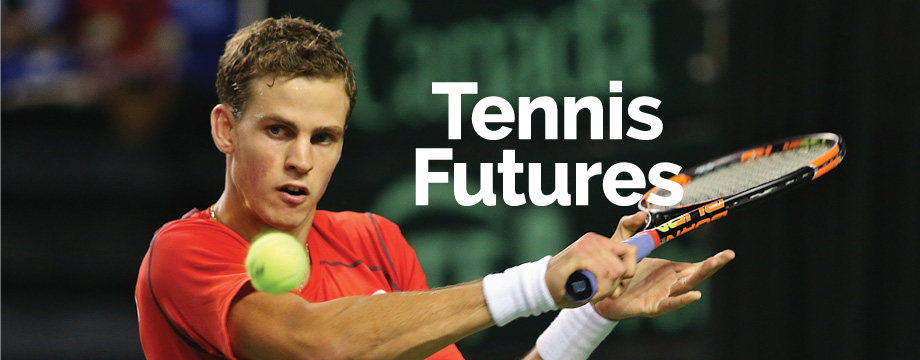
It was an overcast July day last summer at the All England Club centre court at Wimbledon when Vasek Pospisil raised the championship cup over his head. Victory on the largest, and oldest, tennis stage in the world came quite unexpectedly to the young 24-year old, who as a child dreamed he could be there one day, if only to compete, well alone win the title.
Now he stood in celebration with doubles partner American Jack Sock at his side. Winning the title for the unseeded pair came as a shock to the tennis world and themselves. At the start of the season, Vasek had pulled out of men’s singles play at the Australian Open with back pain and had only just began to feel better as the summer grass-court season arrived. His unknown health status had left him heading to Wimbledon without a doubles partner, until an unexpected text arrived from Jack.
“I was ranked 30 at the time and he needed someone high-ranked and I didn’t have a partner at the time,” said Vasek. “When we didn’t do that well in singles, we gave the doubles a go, and tried our best. It ended up being the best week and the best tournament in our careers.”
In a three-hour match that came down to the final game and a fifth match point, the pair made tennis history and Vasek became the third Canadian ever to win a Grand Slam title. In a world tour that crosses every continent, the top four tournaments with the most ranking points, prize money and competitive play make up the Grand Slam: the Australian Open in mid January, the French Open in May, Wimbledon in July and the US Open in September. Achieving a “grand slam” refers to capturing all four titles in a single calendar year, a feat last achieved in single’s men play in 1969.
Starting at Love
The 2014 Wimbledon victory begins with a father’s sacrifices made for a son, and a game that starts with love.
Vasek’s father, Czech-born Milos Pospisil, immigrated to Canada to sunny Vernon in the Okanagan Valley where he would work at the local brewery, raise his family and share his passion for the sport with his three sons.
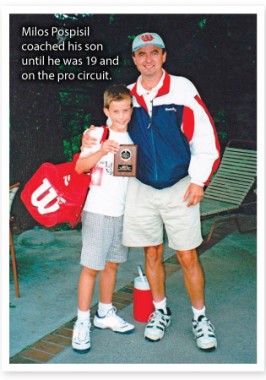 “My dad is the reason I am where I am,” says Vasek. “He’s passionate about tennis and started coaching my brothers, and when I came along started coaching me. I fed off his enthusiasm and passion, and I fell in love with the game too.”
It’s a passion that fuelled a lot of travel time for the youngster. Every day for almost six winters, they’d travel down to Kelowna to use the indoor courts and hit against top club players, then make the 40-minute trip back home in the dark and snowy roads.
At the age of six, Vasek played his first tournament (an U12 competition) and to the family’s delight, ended up winning the whole thing. By the time he was nine years old, he’d won the U9 Little Mo US Nationals, but as he writes in his web biography, “I shouldn’t brag too much because I played against a little girl in the semis and the tournament didn’t really have enough kids to even make younger categories.”
The young Vasek was competitive and confesses he would often sneak into his brothers’ room to count how many trophies each of them had and then tallied his own in hopes of surpassing them. That competitive spirit still drives him.
“I have big dreams and big goals but I’m also realistic, striving for what I can reach at the moment. For sure, my goal is to crack into the top ten, but as soon as I reach a goal of mine I’m never really satisfied where I am. I am so driven and so want to improve, so if I continue with that mentality and frame of mind there is no telling where that will take me.”
Improvement is a constant mindset for the young athlete who says, “every time I step on the court I’m trying to get better.” It’s a work ethic supported by his entire family.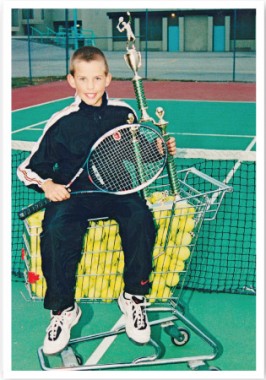
To advance his tennis career, the Pospisil family moved to Vancouver when he was only 12. He, his mom, brothers and two golden retrievers all lived in a one bedroom apartment just a few blocks from the tennis courts in the Kitslano community, courts that now bear a plaque outlining the young tennis player’s fame. The ceremony took place during the 2015 Davis Cup this March and Vasek fought through emotions as he offered a heartfelt thank you for his family’s support.
For two years, Vasek worked with new coaches in Vancouver?—?the first lessons from anyone other than his dad?—?while Milos stayed in Vernon, working harder than ever and trekking out to Vancouver to see the family during the weekends.
During those father-son weekend matches, Milos noticed that his son’s footwork, always a strong point, was sluggish and technically flawed and he grew increasingly unsatisfied with the coaching change. In September 2004, he made one of his last trips back to Vancouver from Vernon, quit his job at the Okanagan Spring Brewery, sold the house in Vernon, and stepped in as coach to his now 14 year-old son.
That next summer, the family travelled back to the Czech Republic. “The tennis centre in Prostejov took us in with open arms,” says Vasek. “They were amazingly open and kind to us and offered me the facilities free of charge.” Throughout his teenage years, Vasek would return each summer season to train and compete on European soil.
Turning Pro
At the age of 16, Vasek would be named Outstanding Junior Male by Tennis Canada in 2007. The accolade came on the heels of his doubles victory with fellow Canadian Erik Chvojka at the Tennis Futures tournament in Sherbrook Quebec, a win that would make Vasek the youngest Canadian to win a professional title. Playing in all three Futures events that year, he earned his first ATP (Association of Tennis Professionals) points following a victory over a Guatemalan contender ranked at 600.
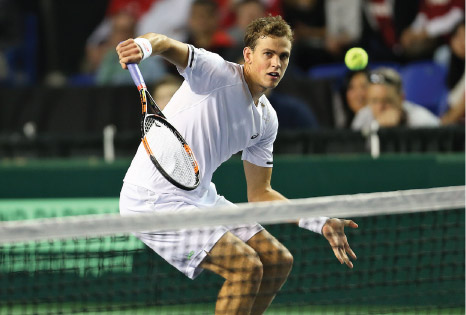
He joined the pro circuit in 2009 and the family kept their summer base in the Czech Republic while making Florida their new winter home. By the next year, Vasek was winning pro titles at Tennis Futures in Toronto and Sherbrooke and the family looked to make a coaching change, hoping to leverage the experience of Frederic Niemeyer, a past Canadian pro.
“There was no doubt that both my father and I, even as far as we made it as a team, were still a bit inexperienced for the higher levels of the professional circuit,” says Vasek. “My father knew that the time would come to put me in the hands of a coach who had played at a high level on the tour and, with Niemeyer’s opening, the timing seemed perfect.”
Stepping up to the ATP Challenger level, one notch below the ATP World Tour, Vasek took back-to-back doubles title in 2011 and 2012, two singles titles in 2012 and the $100K Vancouver Challenger title in 2013. A week later he would compete on this country’s national stage for tennis, the Coupe Rogers 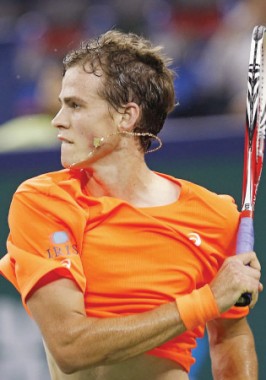 in Montreal. Since 1881, the best players in the world have showcased their skills on Canadian courts. Only Wimbledon and the US Open have longer histories than this major Canadian stop on the ATP World Tour calendar.
Here on Canadian soil, Vasek would capture his first win over a top-10 player, sending him to number 40 in the ATP world rankings. Facing fifth-seeded Czech native Tomas Berdych in the third round, he took the match in a third set tiebreaker before the roaring home crowd. Then blasting through the quarterfinal, he fell to a familiar foe, fellow Canadian teammate Milos Raonic in the semi-final.
Not only had Vasek reached his goal to break the top 50, he had became the second highest-ranked male singles player in Canadian history, behind Milos who had broke through to the top 10. The new rankings marked the first time Canada had two players in the Top 50.
The Canadian Secret
Like Vasek, Milos Raonic has honed his game on European soil, working many years with Spanish coach Galo Blanco. Galo was at the Kelowna Tennis Futures last summer working with another up-and-coming Canadian, Vancouver native Felip Peliwo, a former junior number one who captured the 2013 Junior Wimbledon title.
Galo believes the young Canadians are working very hard and that’s why they are so successful. “There’s no secrets in tennis; the only secret is work, work, work; and the hard work pays off obviously.”
For National Coach Martin Laurendeau, the Canadian secret to world-class play runs just a bit deeper. “Deep down, there’s more belief in the players that are playing the sport at that level. They’re seeing someone do something that’s never been done before, then training with that person, and knowing they have beat him, believing, ‘I can do it too.’
“Everyone is being pulled upwards with this belief that it’s just not the other nations that can have these results, we can. We train hard; we train well; we have everything in place. We have no excuse, it’s a matter of believing it can be done.”
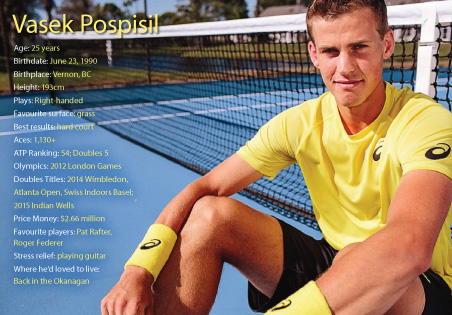 Martin coached Vasek at the Davis Cup, the international tennis team championships. Since their win in 2011, the talented Canadian squad has been a regular member of the elite 16-team World Group.
At the Davis Cup, Vasek got a chance to step out of teammates Milos’ shadow as Canada beat Japan 3-2. His straight-sets single’s victory in the fifth and deciding match against Go Soeda sends Canada to Belgium to the Davis Cup quarterfinals this July.
“Representing Canada at the Davis Cup is one of the most special weeks of the year for me,” says Vasek. “I’m pretty patriotic and proud to be Canadian. I always wanted to represent the country.”
Vasek has worn red and white for six Davis Cups and at the 2012 London Summer Olympics Games. Following the Games, he began training with coach Frédéric Fontang of France, focusing on a more aggressive style of play.
“It’s not necessarily what you saw on the court two or three years ago, it’s something that is relatively new in my game. The game is very physical and everyone is playing very fast and you can’t be passive watching for mistakes. If you can start dictating play then you have to take advantage of that right away because the top players all do that.”
With more success on the court, his newfound confidence is driving the young player to train even harder. “That’s the crucial thing,” he says. “As soon as you seem to be satisfied with the result you are having, that’s pretty much the end of your improvement as a player.”
Canadian tennis fans can rest assured that day is a long way off for the Vernon native, whose belief in himself is pumping strong. You can hear it in the echo of his motivational phrase that has become his fans’ new mantra, “Anything is Pospisil.”
[downloads ids=”130450″ columns=”1″ full_content=”yes” thumbnails=”false”]
Read more of the original stories celebrated in our 30th-anniversary issue.
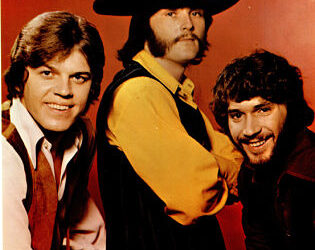
Stampeders take the main stage at Peachfest
One of the most successful groups in Canadian music history will be headlining at the 67th annual Penticton Peach Festival. The Stampeders will be on the main stage Saturday, August 9. The original trio of Ronnie King, Rich Dodson and Kim Berly will be making their...

Okanagan living at its finest | Fawdry Homes
Live the Okanagan dream. Fawdry Homes (voted Best Residential Builder) builds spectacular custom homes throughout the Central Okanagan.

Okanagan Arts Awards set for March 22
The 7th Annual Okanagan Arts Awards is set for Saturday, March 22, 2014 at Kelowna's Rotary Centre for the Arts. Buy tickets now. The Arts Awards Celebration Gala will showcase a number of incredible Okanagan and Thompson artists. The Arts Council of the Central...

Ballet Kelowna: Dancing to a new tune
Like singer-songwriter Joni Mitchell tells us, ‘you don’t know what you’ve got til it’s gone’ and when it began to look like Ballet Kelowna was going to have to close their doors forever, it brought forth a whole new drive and passionate outcry from the public. They...
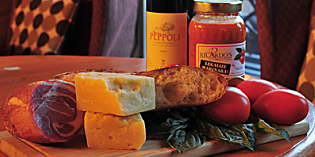
Kitchen Confidential with Chef Ricardo Scebba at Ricardos
Ricardo Scebba says taste is a matter of honour—honouring the lessons taught to him by his mother The tradition of great Italian food in the New World goes right back to Columbus, but for Ricardo Scebba it’s a family affair. His mom, Concetta, taught him the basics...
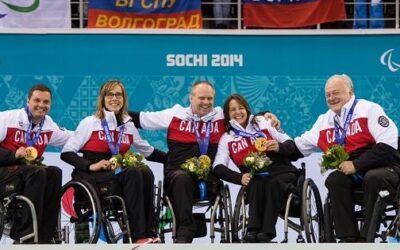
Canada wins gold in wheelchair curling
Canada won an unprecedented third consecutive gold medal in wheelchair curling today at the Sochi 2014 Paralympic Games, beating Russia 8-3 in the final this afternoon after beating China 5-4 in the semi-finals in the morning. Third Ina Forrest from Armstrong, BC...
0 Comments